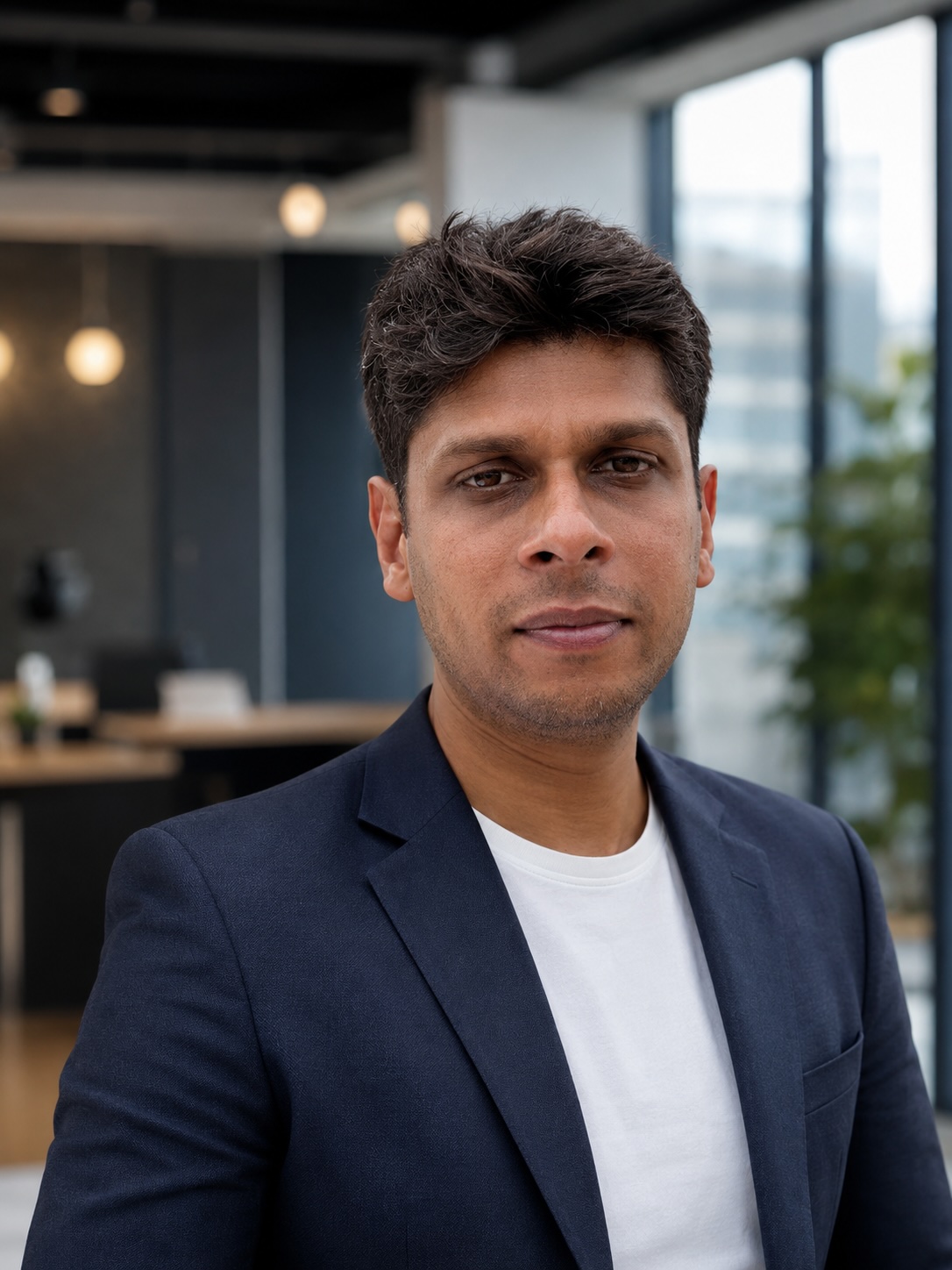
Available for select engagements Bangalore, IN Co-Founder & CTO
Saiprasad Natarajan
Saiprasad Natarajan Applied AI · Fractional CTO

Technology, handled

Focus on what you do best.

Your business. My experience. We grow together.

Every wave of new technology brings the same pressure: adopt it fast, or get left behind. I've been through enough of these waves to know what actually matters — and what's just noise. You run the business. I'll handle the technology underneath.

01 Applied AI & GenAI consulting
02 Cloud & application engineering
03 Fractional CTO & technical advisory
04 AI agents & workflow automation
What I believe

Everyone's selling AI.
Very few know how to ship it.

AI adoption has a problem. It isn't the AI.

The hard part was never the model. It's the business logic, the evaluation, the middleware, the guardrails — the unglamorous engineering that turns a demo into something a real user can rely on. Two companies and sixteen years of corporate engineering taught me where that gap sits. Closing it is what I do.

Three shapes of the same conversation.

The leap — and what came after.

Dotcom Cloud AI ↗

Three technology waves shaped this career, but only the third one I saw clearly enough to bet on.

When the dotcom boom happened, I was still in school. When the cloud movement arrived, I was inside it — building, migrating, leading — but I didn't fully understand what it meant for the businesses underneath until years later. When the AI wave started building, I caught it earlier. I saw an opportunity to do something on my own — and that's how Pangea Tech started, in 2019, bootstrapped from a conviction.

A few years in, the conviction sharpened. AI was here, but something was still missing — the gap between what models could do and what businesses were actually getting from them. Intelligence, I realized, is only worth what it's wired into. That's where Antesian Software Labs came from: the engines that run real businesses, and the layer that makes the intelligence inside them reliable.

And one lesson kept repeating itself across both companies: generic products don't work for AI. If AI is going to be useful, it has to be custom — tuned to the workflow, the data, the business it sits inside. That's why the consulting and fractional work exists. Not as a side offering, but as a deliberate choice to stay close to the problems — because the problems are where the answers live.

Two companies. One mission.

Both solving different layers of the same problem — making AI actually work for the businesses that need it.

Read the Pangea Tech story

Pangea Tech

Bootstrapped · 2019
Clarity, not just code

Founded on the Context Paradox — AI that's brilliant in theory and useless in practice. Pangea builds transparent, explainable AI that enterprises can actually understand and rely on, inside real workflows. Bootstrapped since 2019.

Role: Co-Founder & CTO Based in Bangalore
pangeatech.net Read the full story
Read the Antesian Software Labs story

Antesian Software Labs

In Build
Intelligence is only worth what it's wired into

One company, two halves — vertical products that run real businesses, and the intelligence layer that makes AI reliable inside any of them. Built on a single idea: intelligence is only worth what it's wired into.

Role: Co-Founder Focus: Applied AI, production-grade
antesian.com Read the full story

The sixteen years weren't wasted. Every layer of what I do now traces back to something learned in those roles.

Swiss Re
Vice President, Cloud Engineering
2019 – 2023

Joined the digital transformation of a 180-year-old reinsurer — the kind of stint that tests whether modern solutions actually survive contact with legacy powerhouses. Started as a Solution Architect, grew to lead the Cloud Engineering Chapter for a business function, and was part of the leadership group migrating 200+ applications off-premise to Azure.

Four years of working at that scale taught me the specifics most engineers never see up close — infrastructure, networks, security, architecture, all under the pressure of a business that couldn't afford to be down. More than anything, it gave me conviction in my own skills. I joined Swiss Re the same year I started Pangea. The two ran in parallel for four years — and by the time I left corporate fully, I knew exactly what I was leaving for.

Curam / IBM Software Labs
Senior Technical Consultant · Forward Deployed Engineer
2011 – 2018

Joined a startup that IBM acquired a year later — and grew, over seven years, from engineer to client-facing consultant flying out to solve problems no documented playbook covered. That's where I learned the lesson that still shapes everything: great technology is useless until it fits the client's actual problem. Tailoring the product to the customer was the work, not a phase of it.

Watson made that lesson sharper. Watching cognitive computing turn into something clients could see results from — that was my first real taste of AI as a thing that changes outcomes, not just a thing on a slide. And cloud arrived around the same time. After years of shipping software via FTPs and CD-ROMs, watching Bluemix replace that whole apparatus left me with a conviction I haven't shaken: nothing in this industry is permanent. Evolution is the only constant.

Infosys Limited
Technology Analyst
2007 – 2011

Four years inside a multi-billion-dollar software machine. Where I learned what it actually takes to build real software at scale — and the lesson most engineers don't reach for much longer than they should: the coding is the small part. The hard part is everything wrapped around it — requirements, scale, handoff, the discipline of building something other people will inherit.

Nokia Siemens Networks
Engineering Intern
2007

The fortunate kind of internship — one where you end up working on technology that hasn't reached the public yet. A few months inside the 3G UMTS space, watching how a field I'd been studying actually moved at the frontier. The fascination it sparked — for how communications technology evolves, generation by generation — never really left.

Two companies. One mission. Every engagement is an extension of the same belief — that the gap between what AI can do and what businesses are actually getting from it is an engineering problem, not a product problem. And engineering problems can be solved.

How I can help you.

Common questions from people who've landed here wondering if this is the right conversation to have.

Fit & what I do
What kind of companies do you work with?

Mostly companies at an inflection point — a funded startup trying to get from demo to a real product, an enterprise team that's been handed an "AI mandate" with no clear path, or a founder who needs a technical co-pilot before they're ready to hire a full-time CTO. The common thread isn't company size, it's a problem that sits at the intersection of strategy and engineering.

What does "Applied AI consulting" mean in practice?

It means I'm in the work, not just reviewing it. That could look like an architecture review of your current pipeline, helping your team build an evaluation harness for your LLM outputs, or designing the middleware layer that makes your AI actually reliable in production. The word "consulting" implies slides and frameworks. What I actually do is closer to embedded senior engineering with a strategic lens.

What's a Fractional CTO, and when does it make sense?

The "Fractional CTO" label is mostly a billing umbrella. In practice it's the full range of what a good CTO does — and a good CTO isn't a strategic leader floating above the work. They're in the pit when it gets tactical: tech strategy, solution architecture, application engineering, security hardening, hiring, vendor calls, and the decisions that are hard to undo. The fractional part just means you get all of that without the full-time headcount. It makes sense when the foundational decisions are high-stakes — bad ones surface eighteen months later, too late and too expensive to unwind — but you're not ready to bring someone on permanently. The value isn't in the hours. It's in having someone who's been there do the right thing the first time.

The problems I solve
I've built an AI prototype that demos well. Why isn't it getting to production?

Because demos and production are different problems. The model is almost never what's missing. What's usually missing is the business logic layer, an evaluation harness that tells you when the model is wrong, guardrails, observability, and the unglamorous middleware that makes the whole thing stable at 2 a.m. on a Tuesday. That gap between "impressive in a meeting" and "something users rely on" is exactly where I work.

We've been told we need an AI strategy. Where do we start?

With your actual workflows, not with the technology. Before picking a model, a vendor, or a stack, the more useful question is: where in your business is human judgment a bottleneck versus where is it the value? Half the AI projects I see are process problems wearing AI costumes. I'd rather spend two weeks figuring out whether something should be built than six months building the wrong thing.

Do you tell clients when AI isn't the right answer?

Often, yes — and that conversation usually comes early. Processes that need fixing, workflows that need automation, decisions that need clearer ownership: none of these get better by adding a language model on top. I'd rather lose a fee than build something that doesn't help. That's not generosity — it's just how I stay useful to clients over time.

What makes me different
How is working with you different from hiring a development agency?

Agencies deliver to a brief. I help you figure out whether the brief is right before anyone writes a line of code. And the engagements that go well are the ones where I leave your team sharper at the end than at the start — not ones where the consultant becomes the bottleneck and knowledge stays with me. If you're looking for someone to take a spec and execute it, an agency is probably faster. If the spec itself is the problem, that's a different conversation.

How deep do you actually go technically?

All the way in, when the work calls for it. I've written production code, designed system architectures, led cloud migrations, and built evaluation pipelines from scratch. What I avoid is reviewing a system without understanding it — that's where expensive advice comes from. I'll read your codebase honestly, sit with your engineers, and tell you what's actually going on under the hood. Where I draw the line is being your developer — that's a bigger waste of your money than my time. If you need execution capacity, hire engineers. If you need someone making sure they're building the right thing the right way, that's the conversation.

How we'd work together
What does an engagement actually look like from start to finish?

It starts with a conversation, not a brief. If there's a clear fit, most engagements kick off with a short diagnostic phase — I need to understand what you've built, what your team looks like, and what "done" actually means before proposing anything. From there it could be a defined project (six to twelve weeks, a clear deliverable), an ongoing advisory arrangement, or a fractional CTO setup. I don't have a fixed menu — the shape follows the problem.

What do you need from us to make this work?

Access and honesty. Access to the people actually doing the work, not just the stakeholders who commissioned it. And an honest picture of where things stand — including the parts that haven't gone well. I've worked inside enough projects to know what a real codebase looks like versus a polished demo, and I'm not here to judge. The engagements that don't go well are usually the ones where the problems stay hidden until they're expensive.

How many clients do you work with at a time?

Deliberately few. The sweet spot for me is around three to four engagements at a time — enough to stay sharp across different problems, not so many that any one client gets a diluted version of my attention. I'm honest when I'm at capacity. The kind of work I do requires actually understanding your context — your team, your architecture, your business — and that doesn't scale if you're spread thin.

How do you charge?

I work on two models: hourly and retainer. Hourly works well for defined, shorter-duration work — an architecture review, a diagnostic phase, a specific project. Retainers are for when you need me consistently over time, typically a quarter or longer. They give you a guaranteed slice of my attention and usually make more sense when the work is ongoing — fractional CTO arrangements, advisory engagements where the problems are still being defined, or embedded work across a full product build cycle. The right model usually becomes obvious after the first conversation.

This sounds relevant. How do I get started?

The first step is a conversation, not a commitment. If something here landed — a prototype stuck short of production, an AI mandate with no clear path, a foundational decision you'd rather not get wrong — reach out and tell me where you're at. Worst case, you walk away with an honest read on whether I'm the right person for it.

Outcomes, anonymized where needed.

Representative engagements across enterprise cloud migration, applied GenAI, and agentic automation.

All case studies →

Turning a veterinary care chain digital-first

Acting Head of Engineering for a new-age veterinary care company — building the team, platform, and digital experience that scaled the business from one clinic to 80+.

Read →

Working through it, out loud.

Occasional notes on AI, engineering, and building companies. Not a newsletter, no schedule — just when something is worth saying.

All posts →
6 min read

Can You Still Recognize Effort?

Someone said my proposal looked "too polished" — they meant AI-generated. I wrote this post with AI too. On the near-impossible problem of telling slop from effort.

Read →

Let's talk about what you're building.

Navigating an AI-first product, thinking through cloud strategy, or looking for a technical co-pilot on a hard problem — happy to have a conversation.